CAMOUFLAGE PEOPLE

Jesus, in the way he lived his life, demonstrated
Something truly amazing –
So, it’s surprising that, even after all these years, we still haven’t “gotten” it.

Big Religion, on the other hand, has acted like an enormous stuffed pillow
With extraordinary capacity to smother spirit –
And, even though it hasn’t been able to muffle Jesus’ radiant words entirely,
It has been effective at “re-interpreting” what he said –
For over 2000 years.

Quite a feat!

In spite of that, the Church never achieved complete ownership of Jesus –
Even though it’s been publicly displaying him,
Like a jeweled pendant for two millennia.

In contrast to these theological contortions, however –
Jesus has always been just another human being –
Teaching us how to love God –
Which, of course – is both very easy and very difficult.

Jesus told us not to try to live like him but, instead, to be like him –
To embrace, whenever possible, truth, justice, and beauty –
And always be vulnerable
To love.

Without his extraordinary example, how will we ever escape all the crazy ideas
We are so constantly fashioning about ourselves –
Faster than eye can follow –
Instantly creating and re-creating a “self” in order to meet worldly expectations.

Camouflage people –
We assiduously avoid any reality
That might turn out to be our actual lives.

WHAT ARE MEN SO AFRAID OF?

“Anyone who speaks a word against the Son of Man will be forgiven, but anyone who speaks against the Holy Spirit will not be forgiven, either in this age or in the age to come.” 12 Mathew 32

The religious traditions that exclude women from a central role vis-à-vis God flagrantly sin against the Holy Spirit. By imposing strictures against women’s relationship with God, especially in preaching and teaching, men, in direct opposition to Jesus’ admonition, are forcefully diminishing the Holy Spirit by restricting it to one half of the human race – since the Holy Spirit is, of course, freely available to all human beings, not just to a single sex, and, certainly – not just to males.

So, what is it that men have been so afraid of? Is it that women’s natural love of nature implies they might also have the potential to be more intimate with God as well? And is that why men, so very long ago, felt an urgent need to manufacture a male “exemplar” God to prima facie exclude all images of women from the godhead? Or might it have been an even deeper fear – that God might actually possess strong feminine aspects?

There’s also been a lack of “inwardness” in our postmodern lives. It’s far easier to project human intelligence “outward” into science and technology, finance and politics, than “inward” where thinking inevitably has to confront emotions and feelings. Ironically, the outward “male” path is easier to follow than the inward “female” one because it’s so difficult for one’s rational thinking to sort out one’s emotions and feelings – especially when we become so “attached” to the latter. However, that’s where most of the “juice” in human life resides – along with an ability to get “real things done.”

Here’s the problem: in men’s traditional approach to religion, “spirit” has not been taken very seriously, while materialism has been avidly worshipped. As a result, the spiritual visions of Jesus, Buddha, and Mohammed have, over time, become transformed by the religious institutions established in their name into a kind of ersatz spirituality – shading into frequently violence-tinged “spiritual materialism.” This has created the kind of spiritual imbalance that, one day, might flip humanity into a final tragic cycle of self-destruction.

The “hard” male-dominant social structures that have created this spiritual imbalance – i.e., the world’s vast, almost child-like, yet extraordinarily expensive military organizations, the constantly morphing multinational corporations, and the West’s “sacred” capitalist economic structures – by common consensus have now gone too far and are currently threatening humanity’s very existence.

In light of all of this, isn’t it time – even past time – to think about spiritually starting all over again – and modestly and respectfully requesting women’s help?

CHURCH LIKE A MUSEUM

Jesus had this idea
That, one day, we might become complete human beings
Instead of remaining, in some part, human animals –

That we might set aside our materialistic desires and fantasies
And live in “reality,” that is, in spirit.

To Jesus – spirit was God,
And the reason we’re prevented from seeing God, face-to-face,
Without dying,
Is the very real danger of seeing ourselves.

In light of this, Jesus preached death to artificial selves
And the rebirth of our true self –

The “pearl” –

After he died, Church officials rushed to designate him as “God” –
But, of course, by then, he was no longer able to stop that from happening.

His finest gift to us was the validation of an active, open, loving human spirit –
While his successors spent their time constructing a spiritual/materialistic empire.

Everything they did, at least in part, led away from God –

So, today, we attend church, reverentially, like entering a museum.

LIKE THE WIND

Jesus taught that the spirit is like the wind. Time is also like the wind, pouring like a waterfall out of the future, rushing through the present, and flowing swiftly out into the past. Space, too, is like the wind, since whatever space we are occupying is always changing – either it’s moving away from us or we’re moving away from it.

So, space and time – our world – turns out to be very much like the spirit, i.e., like the “wind”. One day we’re born at a specific place and time and the next day we’re dying at another place and time. In our lives, we’re blown like wind through these two points when, after carefully consulting our minds and hearts, we’ll discover we retain only our spiritual experiences –the love, truth, justice and beauty we’ve created in our lives – while nothing else remains.

From “Diner Mystic”

IF YOUR MIND IS FULL OF DEAD SNAKES

If the God you worship is a true God –
But your heart lives in a trash dump –
What do you think you’ll see when you look at God?

If your mind is full of dead snakes
That you mainly enjoy counting –
Then a God who’s constantly offering fresh spiritual life
Will probably never get noticed by you.

If you believe life is truly a miracle –
Spontaneous – one of a kind –
Why restrict yourself to a regular routine –
Never contemplating the possibility of surprises?

If you don’t deeply yearn for the Spirit –
And always hold tight to the material –
One day you’ll discover your heart’s been moving in the opposite direction from joy.

Materialism isn’t bad, per se – it’s what sustains the Spirit –
But if our hearts only desire more things –
While refusing to open up to the Spirit –

Eventually – we’ll fall down –
Turn to dust
And blow away.

So say the prophets.

HOW QUICKLY CAN CHANGE COME – IN INSTITUTIONAL RELIGION?

Are religious institutions subject to evolution? And, if so, how quickly can change come within them?

In species evolution, it can take millions of years for a significant change to occur, but, sometimes, it can come much more quickly, e.g., in just a few generations for bird beaks that can no longer effectively open naturally-available seeds. (See, The Beak of the Finch, by Jonathan Wiener, Knopf, 1994).

But religions seem to roll along for millennia without much change even though, today, if humanity doesn’t soon begin experiencing a world-wide democratic spiritual transformation, the earth may be in serious danger from the collective grave military, environmental, and health threats currently confronting us.

Today, though, priests still find themselves standing behind their sacramental tables holding up what they believe is holy.  Or reciting age-old stories, with a bit of effort to make them fresh. However, only once in a very long while, does an individual person come into the world and propose major spiritual changes. But, unfortunately, soon after they die, they’re replaced by previous ancient spiritual mechanisms that have been re-formulated by the kind of people who want to earn a living and gain respect from the management of religion.

Because so few people have ever seriously attempted a major revision of religion – and they have usually arrived so far apart in time – there’s always been plenty of room for the managers of religion to manipulate the new spiritual ideas and images into something else entirely.

That’s why we need to have a lot more of these people – a really lot! And they need to keep coming.

If that happened, perhaps in just a few generations, like the finches, human beings as a species might start experiencing profound and permanent spiritual change. And later, looking back, people might wonder what took so long.

So, are we ready to take a peek outside our seemingly unchangeable false selves and religious institutions to begin a fresh search for a true God, as well as for our true selves?

Wait a minute, you mean now?

Yes, now – why not now?!

IF GOD IS “SPIRIT” THEN, BY DEFINITION, GOD IS ABSOLUTELY FREE

God needs this kind of freedom in order to be God. But, if that’s so, then religion and spirit may be incompatible.  Jesus taught that God is “Spirit,” like love – or truth, justice or beauty. But isn’t it true that Spirit can never be experienced by insensate institutions – but only by individual human beings?

Each institutional religion provides a “spiritual” foundation for itself by adopting a set of ideas (orthodoxy) and practices (orthopraxy).  But if God is absolutely free, then how is it possible for people belonging to such an institution to find God simply by agreeing in advance where God can always be found – both in word and deed?  Since God is “like the wind,” always on the move, we also have to be ready to move at any time if we ever hope to stay close to God.

Given that we need to stay on the move in order to be holy, we should resist the temptation to define ourselves in a formal way or to accept any kind of set identity – because, in doing so, we’ll eventually get frozen in place, even though the Spirit will continue enjoying ongoing “play” in the universe.  We also shouldn’t try to define God either because that would only be a futile attempt to “stop” God’s movement (even if only in our minds) – which is impossible.  If God ever “stopped,” and became a stationary idea, image, or name, then God would no longer be “like the wind which blows wherever it pleases,” as Jesus described the nature of God in John 3:8.

What I’m trying to say is that religion may be antithetical to Spirit, that is, to God.  Whenever a person commits himself or herself to a specific religion, they almost immediately abandon (at least for a time) their individual search for God.  Religions offer us packaged “Gods,” and broadcast to the world that they have all the answers to life’s most important questions. But, actually, they don’t have these answers because our questions are constantly changing, we are constantly changing, and God is also constantly changing as well. Consequently, many (or most) of our accepted conventional ideas about religion may be wrong.  If God is “like the wind,” it makes no sense to dedicate ourselves to religious orthodoxy or orthopraxis, much less to church buildings, holy books, creeds, or academic credentials required to become a religious leader.  Unfortunately, we have gotten this all wrong!

The first thing we need is to become as free as possible – in our souls, our spirits, and our lives. Spiritual evolution is contingent upon how much freedom we’re able to attain for ourselves. For human beings, freedom opens the door to attaining everything worth having: the ability to tell the truth – all the time; to love and to be able to actually achieve it; to be as spontaneous as children; to be just – that is, able to do the right thing at the right time; and to end up living lives in “heaven on earth” – experiencing and fully enjoying all the beauty that surrounds us.

With sufficient freedom, even if starting off basically as human animals, we’ll eventually be able to become human beings – just like Jesus, Buddha, and Mohammed and many others have done.

In sum isn’t it obvious that it’s largely impracticable for us to reach God by committing our time and energy to an external “social vehicle” like religion?

This is the principal reason why spirituality is becoming ever more popular and institutional religion increasingly less so.  Religion, historically, has not been able to resist getting itself mixed up with power, with the consequence that people have not been as successful as they might otherwise have been in tasting the “sweetness of spirit” in their lives – the kind of infinite joy that’s potentially available for all of us.

The incontrovertible proof that religions have been “anti-spiritual” in nature is the fact that, in all of them, asking critical questions is strongly discouraged. But how anyone thinks they can reach God without first asking a lot of questions and making many mistakes is beyond me. Why aren’t all questions valid, at least for the asking, no matter how stupid or naïve they might be?

God, like the wind is always on the move – everywhere and at all times. That’s why some religions refuse to countenance any image of God, or even word for “God”. How can you name or picture “Spirit” that, by its very nature, is unceasingly on the move? Humans have wanted to mold and worship a stationary God who’s “dead in the tracks” so they can believe it might be possible to exercise some form of control over such God. Well, even though the managers of these religions have been able to control the language and images their particular religion uses for God – such people will probably never be able to actually encounter, much less develop a deep relationship with the divine.

So, my question is, is it possible for us to start all over again – even though it would be painful to acknowledge wasting so much energy over millennia on a wrong idea – i.e., the attempt to institutionalize “Spirit” – which by definition can’t work? In fact, isn’t it true that the greater effort we put into institutionalizing Spirit, the farther we’ll eventually end up from God.

Let’s try spiritual freedom – trusting in the spirituality of actual individuals. If this happens, it’ll be alright. No – more than that – it’ll be really good!

I promise.

WHY IS THE BOOK CALLED “DINER” MYSTIC?

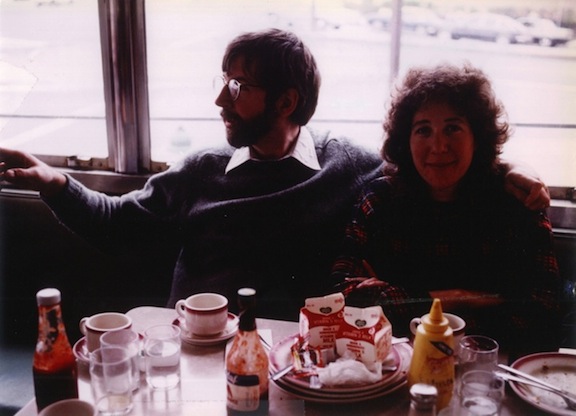
It’s because there’s nothing more democratic than a diner!  I just love diners!  They’re open, accepting places where one can read a book, drink countless cups of coffee, and not have anyone bother you.  You might get a side-glance when you first go in, but soon you’ll be no more interesting than day-old pie – just part of the scene – which might include teens on a date, fingers entwined across the table, smiling at one another and sipping strawberry milkshakes; or an elderly retiree on a careful budget, solitarily nursing a cup of black coffee; or a bus driver who knows the first names of all the waitresses, ordering eggs “over easy,” along with country-fried ham and biscuits; or a local crazy person drooling on his shirt and mumbling irritably, so long as he’s not too loud and, even if he is, the waitresses will simply give him a “Shush;” or a businessman reading the financial and sports sections, eating a slice of apple pie while taking a break from his office pressures; or a group of women friends, grateful for a bit of uninterrupted time, delightedly sharing the neighborhood’s hot and cold gossip.


The light inside diners is usually bright enough to read by given the combination of daylight and indoor fluorescent lights.  Outside, the traffic is rushing continually by – which is part of what makes diners so pleasurable – the outside world rolling by in a constant stream of moving lights and colors while we’re sitting comfortably inside, food on the way.


Diners themselves, however, aren’t really mystical in any true sense – except maybe passing in the night – but they do offer the single most important prerequisite for mysticism – clear and open spiritual space.  Diner space has unique emotional, psychic and cultural aspects.  For example, no matter how crowded a diner gets, there’s always enough room for everyone to get in.  Even more, diner space is democratic space – i.e., there’re no special privileges in diners – no one has to make way for anyone else.  Everyone takes their own turn – and can end up in a booth if that’s what they really want.


“Diner” mystics need the quality of freedom that’s available in a typical diner.  Anyone, however, who believes they’re better than other people, whether due to higher education or greater knowledge, income or status, will never qualify as one.  Diner mystics know, without thinking much about it, that they’re nobody special, and so are happy to take a seat in the next free booth, pick up the plastic-covered menu sitting on the table, and enter their own personal diner “heaven”!  No one in their right mind would think that they can go into a diner and demand that everyone bow their heads in prayer or insist that the customers recite religious formulas together.  If the waitresses couldn’t get this kind of person to leave, the cooks would, and if the cooks couldn’t, the highway patrol who are always sitting in the back nursing coffee, certainly would.  My advice is to test everything you’re told the same as you would if you were sitting happily in your favorite diner.


The Jewish version of diner is a delicatessen, but with better pickles.   Everything else is pretty much the same – a community hangout.


Once, long ago, God decided to send some lofty souls down from heaven (Hasidic teachers) to illuminate the darkness of exile in the Russian Pale.  In like manner, God may, one day, send a few diner mystics down to us – brilliant sparks of spiritual light to sit in the back booths of diners, waiting for a signal to spiritually light up America.  In early Christian times, it wasn’t uncommon for mystics to sit on tall columns out in the desert.  Today, a “diner” mystic might be sitting on a counter stool, turning slowly back and forth, holding a cup of bitter-brewed coffee, and available to anyone who’s able to spot her.


Denny’s will never be a “real” diner.  Chains, by definition, are in an “anti”-diner category.  No true mystic would ever eat in one!  Un-chained diners, on the other hand, operate free of franchise regulations.  The cashier who’s worked there 20 years can say whatever he wants, for good or ill, while you’re paying your check, while the waitress who’s been working there more than 30 years will have her own personal style of tossing the plastic menus onto the tabletop, saying: “Coffee now, hon?”  Diner employees frequently are from the same Greek family or may be their next door neighbors.  A diner is a lot like a home.  Families in homes aren’t required to live subject to the requirements of a franchise manual.  Can you imagine a mother having to consult her franchise handbook before deciding where and when to send the kids out to play or to determine how many times a week she’ll be making love with her husband?  People living in families do anything they want!  They can be as functional, dysfunctional, enlightened or dim-witted, as they wish.  It’s a “free country – and diners fit a free society, perfectly.


Why am I taking all this time to talk about diners and what, if anything, do they have to do with “mysticism”?  I think it’s commonly agreed that there will be no real spiritual life without at least a certain minimum level of humanity.  But how will people be able to achieve this if the world becomes increasingly regulated by the institutional requirements of multinational corporations which are now intruding, consciously and unconsciously, into every facet of our daily lives?  The franchise itself is just a tiny nut or bolt in a much larger more elaborate corporate machine, designed by financial, legal and corporate experts working in mega-cities, like New York, London or Tokyo, who are striving to satisfy the quarterly financial requirements set by the investment world.  Franchisee employees are fungible, paid at the minimum legally-required level, and treated as temporary in every respect, usually with no health or other employee benefits.  Even the local managers are temporary.  In general, you’re never going to develop a deep personal relationship with a franchise employee, except by accident.  They have to do what they’re told, by carefully following the franchise regulations and procedures.  Nor are you ever going to meet (nor would you want to) any of those responsible for preparing the franchise manual or managing the parent company. Yet it’s impossible for you to escape their influence.  Franchises, along with the policies and procedures by which they’re run, are these people’s personalities projected into your world.


We need a lot more un-chained family diners in this country so as to restore civilized space back into our lives.  The same would be true of family-owned pharmacies, toy stores, farms, etc.


Isn’t it a fact that our economic system has now evolved itself into a worldwide Darwinian money game, favoring those most skilled at playing competitive intellectual games?

Do we really want to end up living inside a worldwide economic machine beyond anyone’s control, even that of the United States Government?  Do we really want a society where the people who end up with the most power and economic resources are simply the world’s best game players?


So, isn’t it about time for diners to start making a comeback!  Spiritually, diners have always been even more open than the churches that sit just down the road.  In a diner, one doesn’t need to affirm a specific belief system.  It’s certainly true that diners won’t take you to God, but they also won’t drive you away from God either.  Diners never waste your time.  They feed you and leave you as free going out as when you first walked in.  Can you really say the same thing about churches?  Don’t you start feeling just a little bit restricted as soon as you enter the church parking lot?  When you decide to join a church, you’ll become aware of the necessity for wearing a “uniform” – i.e., required exterior (clothes) and interior (doctrines).  Diners, however, aren’t bothered about what you wear or think – whether you’re orthodox or unorthodox.  Jesus himself was totally open to people – just like a diner.  Anyone could come by, sit at his table and talk about God.  Diners stay open 24/7 while churches, for the most part, are open only a few hours a week, mainly on Sunday.  As a consequence, going to church is often wholesome, but is not necessarily holy.  True holiness isn’t found in crowds, even well-behaved, well-dressed ones.  Real holiness is usually a solitary affair.  When a radiantly holy person enters a diner to eat breakfast – no one thinks a thing about it.  That same holiness, exhibited in church, however, will probably make a number of people in the congregation pretty uncomfortable.


God flashes brief glimpses of Spirit down among us –usually in the deepest ambiguities of our lives – the times and places we’re the most fragile, puzzled and uncertain how to proceed.  It’s the people who don’t think they know everything, and simply want to be with God, who usually turn out to be God’s people, that is, the nobodies.  You can find them whenever you just take the trouble to look – in fact, they’re probably sitting at the counter in your local diner right now!


The kind of person who might be reflecting on God in a diner is certainly not restricted to any specific religious tradition.  They’re able to allow all kinds of religious and spiritual thoughts to reverberate freely throughout their minds and souls.  They might even let themselves take a few minutes to have fun “playing” with God.  One day, I sat down and tried to think about God from as many different angles as I was able.  What I came up with will be my next post – “Kaleidoscopic Images of God”.